
Researched by Richard Curtis, Lead Volunteer on Collections.
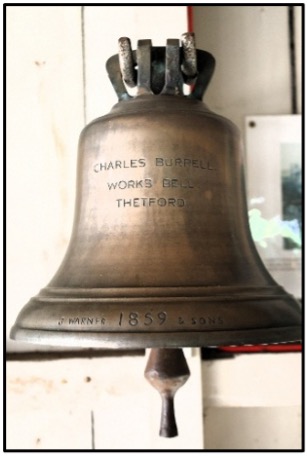
Vistors to the Charles Burrell Museum can ring the brass bell that governed the working day at the St Nicholas Works, but few understand its history or purpose.
The Burrell Bell was cast by John Warner & Sons in 1859 of Jewin Street in the Cripplegate area of London. Charles Burrell would have been aware of this firm because they were also respected hydraulic engineers. They made ‘every description of machinery for raising water by means of wheels, rams, deep well pumps, &c’, devices that they demonstrated at the same Royal Agricultural Society and county shows as Burrell.
The bell would have rung by the firms timekeeper to mark the start and end of each working day. The timekeeper also had responsibility for monitoring and recording staff attendance and timekeeping, information used to calculate the wages earned by each member of staff.
The timekeeper was, therefore, an important position of trust within the firm’s management hierarchy.
One of the most characterful timekeepers employed by Charles Burrell was Mr Jones Wilson who occupied the role between 1904 and 1912. He joined the firm after a long and distinguished career in the army – he joined the Rifle Brigade in August 1881 having previously been a collier in Lancashire. He served in India and Burma and on his return to England as a quartermaster sergeant he had a lucky escape when the ship he was on collided with another vessel off the Cape Trafalgar coast of Spain and his lifeboat was one of the few picked up by another ship.
Prior to retirement from the army in 1903, after 21 years’ service, he was an instructor at Sandhurst and on the Isle of Wight serving with the 2nd Battalion Hampshire Regiment. Jones Wilson’s army career did not end there. Two years after leaving Burrell’s he enlisted to serve in World War 1, where he served with distinction across multiple theatres. In the Sudan, he served as a major in the Egyptian Camel Corps. Later, as a Lieutenant and 2nd Lieutenant with the Suffolk and Essex regiments, he was deployed to Egypt and Palestine, where he was present at the capture of Jerusalem.
It is not clear how Jones Wilson came to Thetford because the 1901 census tells us he was a widower and lodging with a young son, Arthur (6), on the Isle of Wight. We can find no obvious connection to the town. He most likely responded to an advertisement as Charles Burrell widely promoted major openings in the press, and the role of a timekeeper would have been the type of structured and disciplined role attractive to an ex-serviceman.
Ten years later, in the latter part of his time as timekeeper, and the 1911 census tells us that he lived at 42 Crofton Road, Thetford, that his son, Douglas Jones Wilson (14) was an apprentice boilermaker with Charles Burrell & Sons Ltd and that Jones Wilson was now married to a naturalised German, Augusta Wilson.
After leaving Burrell, and before enlisting for WW1, Jones Wilson remained in Thetford and became an organiser for the National Conservative Party, undertaking duties that took him all over the country. After the war he went to France as an officer of the Chinese Labour Corps, a post he gave up in 1920 when he returned to Thetford and went into retirement. He became a director of the Thetford Gas Company and was known in the town for helping ex-service men, especially with regards to applications for war pensions.
Jones Wilson died on 26 January 1937 in Thetford Cottage Hospital aged 74. At the time the family lived at Fairfield, Station Road, Thetford. The Bury Free Press (Saturday 30 January 1937) and other local papers carried his obituary – ‘Death of Mr Wilson Jones. Well-Known Thetford Resident’.
————————
There is also an interesting side story to tell.
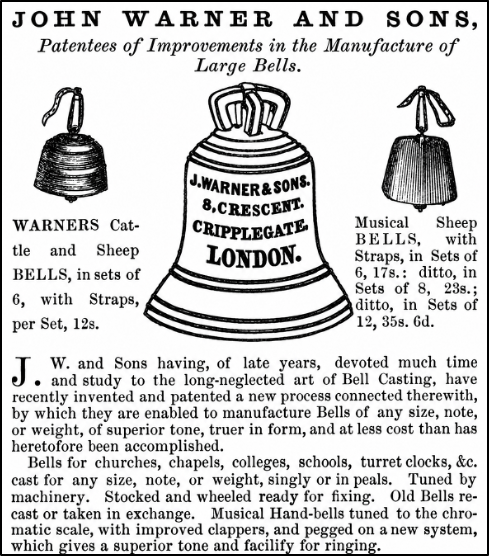 Click the image to view in full size.
In 1856, three years before making the Burrell Bell, John Warner & Sons secured the order to make a casting for a large bell for the newly built tower at the Palace of Westminster in London (the Great Bell we now know as ’Big Ben’).
Unfortunately, the casting made by Warner at its Stockton on Tees foundry cracked irreparably during extended testing in 1857 and had to be melted down. The job of recasting the bell was offered to Warner’s but the price they quoted was considered too high, which meant that ‘Big Ben’ (which weighed some 13½ tons) was instead cast by the Whitechapel Bell Foundry in 1858. John Warner & Sons did, however, cast the largest of the quarter bells used in the clock tower.